Showing posts with label Afcon 2013. Show all posts

Wednesday, February 13, 2013

Afcon 2013 Videos

I've finally found the video clips of Afcon 2013 on my camera. Here's a little slice of what it was like at the tournament.

1.) South African fans getting irate at the score-bore between Bafana and Cape Verde.


2.) The closing ceremony starts but it's difficult to see the pitch.


3.) Despite going 1-0 down in the final, the Burkinabé drum and dance relentlessly.


4.) Final whistle goes, Nigeria run onto the pitch and the crowd celebrate.


Monday, February 11, 2013

Like the World Cup should have been

In the couple of days leading up to the Afcon final, street vendors began to appear selling Burkina Faso and Nigeria flags. This was far from the mass scale of flag-selling during the World Cup but it was still a sign that the Afcon party was belatedly infecting Johannesburg.

Want a flag?

Even the metro cops were joining in

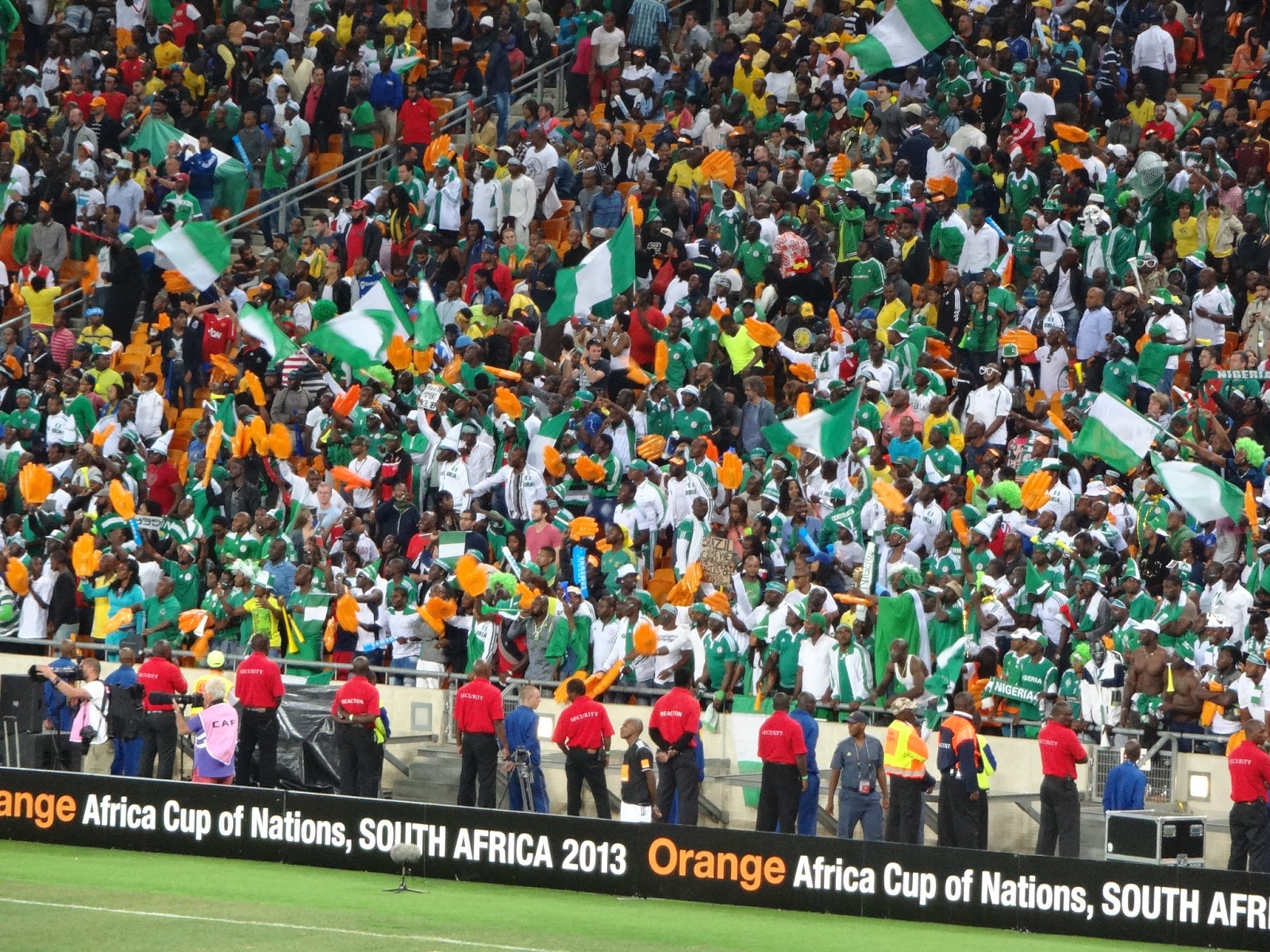
Having made the decision to turn up extremely early to avoid the traffic chaos that I had experienced earlier in the tournament, my friend Chris and I arrived with a little less than four hours until kickoff. Even at this point, crowds were slowly streaming into the stadium precinct. Flags, vuvuzelas, body paint, makarapas, whistles and singing created a buzz. The vast majority of people were supporting Nigeria. This is perhaps unsurprising considering the large Nigerian community in the city, especially in the central areas of Hillbrow and Berea. What was surprising was the number of South Africans also supporting the Super Eagles. Crime and criminality have become associated with Nigerians living in the city and it is all too easy for people to blame 'Nigerians' for the city's problems. This football match appeared to turn this association upside down; being Nigerian or associating with Nigeria had become a positive thing, if only temporarily.

Nigerian fans already in party mode
African media agencies pounce on the partygoers
Walking towards the spectacular stadium, it was quickly apparent that this was unlike the World Cup almost three years previously. As football fans, we had been promised an African World Cup (whatever that entailed). After all, we had been repeatedly told that "It's Africa's Turn" and that South Africa would show the world what Africa had to offer. Instead, we were met with the bland, commercialised environment in which we could only consume official sponsors' products. Despite the introduction of cheaper category four tickets for South Africans, high ticket prices barred many of the domestic football supportership from participating. The local flavour of the tournament had been reduced to vuvuzelas. As one of my research informants summarised, "this could be anywhere!"
Sorry mate but Tunisia didn't qualify
I bet they did
This time was different. Cheaper tickets must have been a factor, allowing those who could be a part of the World Cup to engage, to experience and to celebrate. The final was a dream for the proponents of the Rainbow Nation. People of different races, ethnicity, class and gender were socialising with one another, dancing, cheering and blowing vuvuzelas together. Yet it was more than that. Whether their team had reached the final or not, the vast array of different African football shirts and flag signalled an wider belonging to Africa. Zambia, Ethiopia, Tunisia, DR Congo, Somalia and Tanzania were just a small number of those I saw.

Firestarters after Nigeria score
Police and stewards 'leap' into action
The bland hot dogs of the World Cup had been replaced with the pap and steak and boerwors rolls, staple foods at domestic matches (although prices had skyrocketed - Afcon final premium I guess. I paid R50 for my pap and steak). The small group of Burkinabé near me drummed from start to final whistle, giving the tournament the beat that had been lacking. Despite their team never recovering from going 1-0 down, they carried on drumming and dancing throughout; an impressive effort. I had been given a giant inflatable orange hand, which I used to hi-five anyone who would let me. Three-quarters of the stadium erupted just before half time when Nigeria went ahead. Some idiots set off a flare, which forced the South African Police Service (who attempted to look casual and sporty in their tracksuits) to 'leap' into action. Despite going through five roadblocks to get to the stadium, the security checks on fans walking in were inconsistent at best. A feeble, half-hearted pat down from a steward would do little to detect things such as flares. This constantly happens at local games; my favourite is still seeing someone pull out a full bottle of whisky from his sock! Although better than the desert that made up the Mbombela pitch, the pitch at the National Stadium still resembled a beach with clouds of sand constantly kicked up by the players. A far cry from the World Cup. 

The Burkinabé supplied the beat

Pitch or beach?
And this creates a problem. I've fallen into the trap of comparing a westernised, modern, slick, commercialised World Cup with the chaotic yet dynamic African tournament. I'm not sure how to extricate myself from this other than to continue digging my hole with my romanticism of the final. It was vibrant, a celebration of African football, and a welcoming atmosphere. Most of all, it was fun.

The game wasn't bad either.

Nigeria fans in celebration

Nigeria prays in celebration as a tiny spaceship descends...
The inevitable traffic chaos ensued after the game as thousands of people tried to get home as quickly as possible, but this didn't seem to matter so much this time.

Nigeria celebrating on the big screen

The final party
Yet, as I drove to work this morning, the newspaper headlines attached to most Jo'burg streetlights were not about the final but Manchester United extending their lead at the top of the English Premier League. Is the 2013 Africa Cup of Nations already being forgotten?

Wednesday, February 6, 2013

The non-return of Football Fridays

I was driving home from work this evening when over the radio came an advert for Football Fridays, telling listeners to wear their Bafana or other African jerseys to celebrate the 2013 Africa Cup of Nations in the country and support the national team. I was surprised when I heard this as it had taken until semi-final day for this to reach me. Now I haven't had my fingers in my ears or my eyes closed throughout this tournament so to only find out about this now is indicative of the weak interest in the Afcon. This was designed to get South Africans 'behind the boys' but the lack of evidence of this happening reveals the muted reaction that the tournament has received, at least here in Johannesburg.

Rewind to the 2010 World Cup and Football Fridays were a much different phenomenon. The initiative created by the Southern Sun hotel chain and subsequently endorsed by the tournament's organising committee, encouraged all South Africans to wear their Bafana jerseys to work on Fridays leading up to the World Cup. While designed to foster a nationwide support for Bafana, it actually reinforced divisions. The official Adidas shirts ranged from R300 to R1000 but those who couldn't afford it/ didn't want to spend that much turned to the vibrant black market in pirated, unofficial Bafana shirts. Football Fridays were a visible success with Bafana shirts seemingly everywhere on Fridays. In the aftermath of the tournament, Football Fridays became "Fly the Flag Fridays in which South Africans were encouraged to continue wearing their Bafana shirts although this quickly flopped.
 
Today, the attempted resurrection of Football Fridays has been the brainchild of Lead SA. The problem has been that there has not been the level of anticipation in the build up to the Afcon as there was for the World Cup, which had built up a critical mass of hype beforehand. It turns out that this time around, the initiative was dead in the water before it was launched.

Still, I shall belatedly enter into Football Friday and wear my Bafana shirt this Friday. Any excuse not to dress smart...

Monday, February 4, 2013

Just like watching England play

Over the weekend, we found out which nations will be competing in the semi-finals of the 2013 Africa Cup of Nations. While Nigeria shocked favourites Cote d'Ivoire, the more significant result from a Jo'burg perspective was South Africa's penalty shoot-out defeat to Mali. Prior to the tournament, South Africa wasn't fancied to progress far. After all, they had failed to qualify for the 2010 and 2012 editions and were only in this one courtesy of being hosts. The form book wasn't favourable and coach Gordon Igesund had only been with the side for six months. Still, after a sluggish (and very boring) start against Cape Verde, signs of improvement were clearly visible in the win against Angola and the battling draw against Morocco. We learned that Dean Furman and Itemelung Khune should be playing at a higher level.

With Bafana's progression out of their group came the overenthusiastic, and sometimes wildly over-optimistic, dreams of grandeur and success that many football fans go through, no matter how irrational. Instead of apathy or a quiet acceptance of Bafana's "inevitable" exit from the group stage, a belief that Bafana could win it emerged, and with that came the comparisons of the Afcon-winning side of 1996. Maybe it was fate that South Africa should win it again on home soil? From nowhere, street vendors had started selling South African flags, which had clearly not been the case earlier in the tournament. Bafana shirts were more visible than before.

What encapsulated this was ticket sales for the semi-final in Durban, in which Bafana would have featured had they beaten Mali. The day before the Mali match, over 30,000 tickets had already been sold and a much larger crowd than in many of the previous games this tournament. A friend had persuaded me to get tickets for this game should Bafana qualify. Four hours before the quarter final, I headed to my local Spar to get these tickets. When I got to the front of the queue, I found out that the ticket machine only had 33 tickets left in it. It turns out that Spar do not hold spare reams of tickets in store but instead have to get someone from the ticketing company to load their machines for them. This supply wasn't going to last very long and the extremely flustered shop assistant was only going to get more fraught.

Worse still. When I asked for tickets for the Durban semi-final, they had all been sold out. Clearly, there were enough people with blind faith in Bafana that they were prepared to gamble on them progressing further. Spare a thought for these people. Mali versus Nigeria could be a great fixture but when you're banking on your team playing, it's going to be an anti-climax. I wonder how many will actually attend this game?? With Bafana out, the atmosphere is flat but hopefully the remaining matches can still be a celebration of the best of African football.

So, Bafana were subject to wildly unrealistic expectations and got knocked out on penalties. It's just like watching England play...

Thursday, January 31, 2013

Owning four Bafana shirts does not make me South African

Yesterday, I bought a new Bafana jersey. I now own four Bafana shirts. I only own three England football shirts. This does not make me South African (despite knowing the words to Nkosi Sikelel' iAfrika).

Bafana shirt number four, and possibly my favourite.

I wasn't going to buy one but with all the Bafana shirts reduced by R200 in my local Totalsports shop, I couldn't resist. After all, I hadn't bought one since 2010. I had toyed with the idea of getting one but the astronomical R599 price tag had put me off. However, at R399, this was enough to make me falter and eventually I couldn't resist.

Yet, through all this, many questions arose and still remain unanswered:
  1. Bearing in mind that the core demographic of domestic football support in the country comes from the black, working class with very limited disposable income, who on earth thought that it was a good idea to charge R599 in the first place?
  2. If people can't afford the national jersey, does this then create a gulf between the "authentic" supporter with their official merchandise and those who have not?
  3. South Africa are hosting the continent's biggest football tournament and they've progressed beyond the group stage for the first time since 2002. It seems strange for a national chain to reduce prices now rather than after the tournament has finished.
What on earth is happening here?

Asking the shop assistant why they had been reduced by a third, he responded with the reason that Bafana supporters could buy the shirt and have money left over to put petrol in the tank or do food shopping. A noble sentiment perhaps but highly implausible that a national chain of sports shops would have such a social conscience.

While I may have been persuaded/ persuaded myself that R399 was reasonable for the shirt, it still remains extortionate for many in this country, especially for those who struggle to pay the R30-50 ticket price for a domestic Premier Soccer League match. Now some may (rightly) disagree here but in the modern, global game, buying the official merchandise of your team/ nation has become a key signifier of your authenticity as a supporter of said team/ nation. My own research on football fans in Johannesburg often bore this out. Sometimes those with pirated copies, out-of-date shirts and those without were seen as a lower level of supporter or fan by those who had the shirt. There were occasions when those who did not have were mocked by those who did. The current PSL league leaders, Kaizer Chiefs, sell two types of replica shirt. The more expensive is the authentic replica made from the same material as the players' shirts but at R599-699, there aren't many regular supporters who will be able to support them. The cheaper "supporters shirt" is made from cheaper, lower-grade material. R350-399 makes this more accessible but still not cheap. There is an economic segregation happening in the stands of South African football matches.

But let's put this into a bit of context. This doesn't just happen in South Africa but is a global problem. The distinction between those who can afford to buy the shirt and who can't and those who can afford the ticket price and those who can't is becoming wider. It's just in South Africa where economic disparity is so great that it is far more noticeable here.

So why has Totalsports reduced the cost of Bafana shirts at this stage of the Africa Cup of Nations? Maybe after all, they do have a heart and are allowing more South Africans to literally buy into Bafana?

Or maybe they just bought far too much stock thinking that 2013 would be like 2010, like many of us here? Unlike 2010, people are not wearing Bafana shirts in the same volume. Yes, you can still see them around on most streets but the apparent apathy has crept in here too. 2010 was a sea of yellow and green; in 2013, the yellow and green is just dotted around. The large quantity of Bafana shirts that I have seen unsold in many sports shops in the city may support this trend. It is not that South Africans are being unpatriotic. Far from it. It is just that they haven't bought into the tournament.

A colleague of mine pointed out that the barometer for all this is the merchandise being sold by informal vendors at major road intersections. During the World Cup, these people across the city sold flags, shirts and vuvuzelas. On match days when the Highveld Lions are playing cricket or the Lions are playing rugby, these vendors will also sell related merchandise (whether 'authentic' or pirated). This time, I have only seen two people sell South African flags. It's as if the tournament isn't happening.

Wednesday, January 30, 2013

Finding a fan park

In a recent post, I claimed that there were no fan parks in Johannesburg for the Africa Cup of Nations but it turns out that I was wrong. Well, sort of.

I had come to this conclusion when driving past the sites of the main 2010 World Cup fan parks in the city to find that nothing was happening. During the World Cup, Mary Fitzgerald Square had giant screens, banners, live music, a large beer tent and numerous stalls selling food prepared by local vendors and local goods such as makarapas (a quintessentially South African football item). A giant figure made up of Coca-Cola crates loomed large and was instantly recognisable from the highway. Crowds of fans from different parts of the city congregated to watch some of the matches, notably Bafana's win over France and the final, in a party atmosphere. This park was run by the city, in contrast to the other two in Sandton (in the north) and Soweto (in the south), which were official FIFA Fan Parks where only 'official' merchandise could be sold and consumed. These parks haven't re-emerged this time, and it has deadened the beat of the Afcon in Jo'burg.

Bafana v France at Mary Fitzgerald Square in 2010. This was the vibe that I was hoping for in 2013

Still, a reader had corrected me on the lack of fan parks in the city so I duly did a Google search. Lo and behold, I found that the city had organised nine fan parks in the greater Johannesburg area. Yet these are not like the fan parks that I've described above. During the World Cup, the city also set up a number of smaller fan parks located in the poorer parts of the city, under the Township TV scheme. Football fans, for whom tickets, transport and television were financially out of reach, could communally watch the games on a not-so-giant screen. However, when I went to these places, I found only small groups of people quietly watching the games. Not the celebratory environment that had been expected by the organisers.

For 2013, Township TV has again been used to reach those who cannot afford to go to the games and to watch them as part of a larger group. The organisers have said that they are expecting thousands to attend the nine parks, where you cannot wish for a more vibey celebration of this continental football extravaganza. It was also promising to read that security has been beefed-up as well.

So I headed down to Joubert Park in the centre of Johannesburg last night. To give you a brief taste, Joubert Park was a whites-only residential area under apartheid but today suffers from urban decay and borders the notorious Hillbrow and slightly less notorious Berea. Part of me thought that I shouldn't be there at night but my research experience there combined with the fact that I had never had any problems there before put my fears to rest.

Problem was that when I got there, there was no sign of the vibey celebration, nor the beefed up security. Only a few handfulls of people were sitting on the grass, watching the match. The screen itself was only three-quarters working, with the score permanently obscured. Commentary was fairly audible, but was underwhelming against the bustling sounds of the surrounding city as people made their way home. I had a few confused stares from people watching the game, as the only white guy there, but there was a general sense of apathy. Elsewhere in the park, the multiple chess games and especially the giant chess game appeared to draw more interest from passersby than the football did.

The 'crowds' at Joubert Park
Where is the vibe?

Yet, I have to make it clear that South Africa have not had long to organise hosting the tournament, which had been scheduled to have been in Libya. They've made a pretty good go of things considering. Burkina Faso v Zambia and Ethiopia v Nigeria were probably not fixtures that were going to alter Furthermore, Joubert Park was not one of the four parks that have been adorned with the local flavour of makarapas, SA flags, vuvuzelas and the patriotic fervour of our soccer fans in support of Bafana Bafana.  

Burkina Faso v Zambia and Ethiopia v Nigeria were probably not fixtures that were going to alter people's daily routines but come Saturday's quarter-final between SA and Mali, these parks may yet take on a new lease of life. Hopefully.

Tuesday, January 29, 2013

Trapped by race

For the first time in ten years, the South African national football team (Bafana Bafana) progressed beyond the group stages of the Africa Cup of Nations. Siyabonga Sangweni’s late strike secured a 2-2 draw against Morocco and first place in Group A. Cape Verde’s shock second place has to be the surprise of the tournament, although knocking out Cameroon in qualifying may have suggested that they weren’t going to be pushovers.

Yet what interests me is how Bafana Bafana have been reported in the papers, especially in the light of their 2-0 victory over Angola. The following morning, much praise was heaped on man-of-the-match midfielder Dean Furman. The Oldham Athletic captain received plaudits from critics and supporters alike for his domination in the centre of the park, nullifying most of Angola’s attacking play. While this was clearly a great personal achievement for Furman, the papers picked up on something that Furman could not help; he is white.

Is the most important thing about Furman is that he's white?

The Sowetan, a daily aimed predominantly at township readers, described Furman as a token mlungu (umlungu is zulu for white person), mentioning that he is one of two white players in the squad, the other being goalkeeper Wayne Sandilands. This begins to hint at just how important race and racial identity still is in post-apartheid South Africa. As a researcher on the social significance of football in the country and having attended many local football matches, I was often the token mlungu in the stadium. I was regularly a novelty and spectators would ask to have their photo taken with me, just because I was white. In Johannesburg, white soccer fans at domestic matches are rare (Bidvest Wits games are the exception) and white first-team players similarly so. Furman and Sandiland’s presence in the Bafana squad have similarly been constructed in the press as unusual, and therefore newsworthy.

John Robbie’s column in the Saturday Star went further:

There have been high profile incidents of rugby and cricket struggling to adhere to racial transformation policies post-apartheid. The Rugby World Cup winning team of 2007 had only two players were not white, despite the fact that it was thirteen years since the end of apartheid. Cricket too has had its scandals surrounding racial quotas; the spat between bowler Makhaya Ntini and now former coach Mickey Arthur springs to mind. Inversely, Bafana Bafana hasn’t had such a problem. The likes of Neil Tovey, Mark Fish, Matthew Booth, and now Dean Furman have shown that an inverse transformation policy hasn’t been necessary. I think that Bafana reflects the national demographic much closer than the Springboks (rugby) or the Proteas (cricket) ever have although in recent years, Bafana squads have been short on white players.

Still, behind the increasing hype/ decreasing apathy surrounding Bafana during this tournament, the attitude that if the Springboks and Proteas are subject to transformation policies, Bafana should be forced to field more white players still exists in some quarters. Alternatively, the conspiracy is that Bafana is already subject to a quota that keeps white players out. Robbie is right to refute such notions; the football team is not subject to a quota system.

What Furman unwittingly highlights is a key contradiction in South African life; race is both important and not at the same time. He is one of a squad of players regardless of race, wearing the Bafana jersey, singing the national anthem and representing the country. However, the sharp focus on his whiteness reveals the continued minefield of race and identity in South Africa.

Wednesday, January 23, 2013

A subdued beat


One of the key sights of this year’s Africa Cup of Nations has been emptiness. Aside from the opener between South Africa and Cape Verde, the TV cameras have picked up images of large swathes of empty seats. Whether it was Burkina Faso’s last gasp equaliser against Nigeria in Nelspruit or Tunisia’s equally late winner versus Algeria in Rustenburg, the empty seats appeared to outnumber the fans that had made the trip. Coverage from previous editions of the tournament in Ghana, Angola and Equatorial Guinea picked up similar images. This is clearly not a South African-only problem.

Empty seats at the AFCON 2013 opener. Other games have had far fewer spectators.

I had earlier hoped that the more reasonable pricing structure for this tournament as opposed to the 2010 World Cup would have made the games more accessible to majority of poorer, working class football fans; those who make up the vast majority of the support base of SA’s domestic clubs. The empty seats suggest that it’s reaching few people in general.

So what are the issues behind this?

Firstly, there aren’t many players in this tournament that can be described as superstars. In the World Cup, there was Messi, Ronaldo and the entire Spanish squad. This time around, there’s Drogba, whose career is winding down in China but few others. Yes, there are players such as Yaya Toure and Asamoah Gyan but they simply do not have the same star status. Why spend hard-earned money to watch two teams that you have little or no interest in?

Secondly, the 5 pm kick off times are hardly conducive to getting bums on seats. As I write this, I have one eye on the Bafana v Angola match. While attendance seems to be significantly greater than in most of the other matches, there are still many empty seats. Traffic at this time in the major cities can be nightmarish and some fans will be unwilling to put themselves through the gridlock and confusion. To make sure that you get to the stadium in plenty of time means taking the afternoon off work.

A big contributory factor has to be that there are few, if any African countries that have a large fan base with a large enough disposable income to fly out to the southern tip of the continent for the tournament. Unlike the vast hoards of travelling football tourists at the Euros or at the World Cup, the support of visiting teams is usually restricted to a small rump of die-hard regular fans who are sometimes subsided by the state or political parties. While the commitment on the part of these fans is impressive, this is not going to fill these former World Cup venue. This is a problem that is not going to go away anytime soon.

But the thing that strikes me most as I write from Johannesburg is the absence of evidence that the stadium is taking place. In 2010, there were numerous posters around the city, large fan parks with big screens and people blowing vuvuzelas on street corners. Thousands crammed onto the streets in the north of the city when Bafana went on an open-top bus tour while a giant photo of Cristiano Ronaldo was emblazoned on Nelson Mandela Bridge. This time, it is severely underwhelming. There is no party atmosphere, no fan parks, little hype on the TV or radio. Bafana shirts are far less apparent on the street in contrast to 2010. It’s not totally absent though. Staff at my local Spar were wearing their Bafana shirts today, while bar staff on Soweto’s tourist strip on Vilikazi Street were doing the same.

Still, it’s as if the tournament has passed Jo’burg by and I wouldn’t be surprised if it passes most of South Africa by with little more than a passing awareness that Africa’s biggest football tournament is in their country. The slogan of the tournament is “The beat at Africa’s feet” but this beat is strangely subdued.

Maybe people realise that they have more important things to do than watch football?


N.B. Moses Mabhida stadium seems to be fuller in the second half. The commentator on Supersport has suggested that there is an excessive number of security cordons, which has delayed many fans from getting into the ground until the latter part of the first half.

Monday, January 21, 2013

Opening game and the search for the imaginary cemetery


If the ticketing process on the day was fairly smooth and unproblematic, the journey to the stadium for the opening games made up for it with its chaos and mayhem. As with the 2010 World Cup, park and ride, and park and walk schemes had been created to help facilitate the smooth arrival and departure of thousands of football fans although this wasn't announced when I tried to find out details only two weeks before the tournament.


The national stadium at night
 
That was the theory. My experience of it was didn’t fit the model.

Having been to many of the 2009 Confederations Cup and seven World Cup matches, I had developed an understanding of how these systems worked and the best ones to use. As with 2010, Jo’burg had multiple park and ride venues dotted around the city, where fans could park their cars and take the Rea Vaya bus transit system (initially introduced in time for the World Cup) to the FNB National Stadium. Alternatively, fans could park their cars at Park Station in the centre of Johannesburg and take the train. The other option was the park and walk, in which large car parking areas around the stadium were used and fans could walk the rest of the way to the uniquely designed ground, sandwiched between Jo’burg and Soweto. I had used this method on several occasions before and found it to be the most convenient way, especially when you knew the shortcut to avoid the highway.

It had started off so well. I bought the park and walk ticket from a Computicket outlet, a national chain of ticket sellers of various sporting and other cultural events. I had identified which area I wanted and handed over my R50.

I should have checked the ticket.

My girlfriend and I drove down to the stadium and I was growing in my smugness of bypassing the traffic queues. We’d driven through multiple police roadblocks designed to only allow ticket holders through and numerous policemen had seen our parking ticket. The problem was that it wasn’t for the area that I had asked for but for the “Cemetery”. I’d never seen or heard of a cemetery near the stadium, and it appeared that the stewards and police hadn’t either. We were told to drive on and turn right. So we did. Then we were told to drive on some more and turn right again. So we did. Eventually we were told later on that we had passed it despite no signs for it and we were clearly not the only ones; many drivers displayed confused looks. Eventually we found what allegedly was the cemetery, although there was not a gravestone in sight.


Yet, while this anecdote is a negative one, I refuse to believe that this was the only experience that match-goers had. Buses full of supporters arrived in the stadium precinct like clockwork, while fans were calmly pouring out of the adjacent train station. I’ll reserve judgement until I have a wider experience of this throughout the tournament.

Still, I wasn’t going to let this spoil my anticipation. Getting closer to the stadium, the wall of vuvuzela noise grew to deafening levels. Love it or hate it, the build-up to the opener between the hosts, South Africa, and Cape Verde was electric. The match had been sold out (although in reality, there were plenty of empty seats dotted around but more on that in a future post) and when the national anthems were played, I had goosebumps. Never had I heard Nkosi Sikelel' iAfrika belted out with so much force and passion, and the subsequent rendition of Shosholoza (an old mine labourers song which is the only song at a national football match that most South Africans appear to know the words) was phenomenal.

There was passion at the beginning of the game but it soon died as Bafana's inability to score became apparent
 
And that was the best it got. For those of you who watched the match, you’ll know that it was a score-bore. Bafana Bafana were clueless and uninspiring. The minnows from Cape Verde at the very least deserved the draw, if not more. Whether this was Bafana’s true ability in stark reality or just a case of opening day jitters remains to be seen.

At least getting home was far easier (apart from when I got lost but I only have myself to blame)…

Hits since April 2010